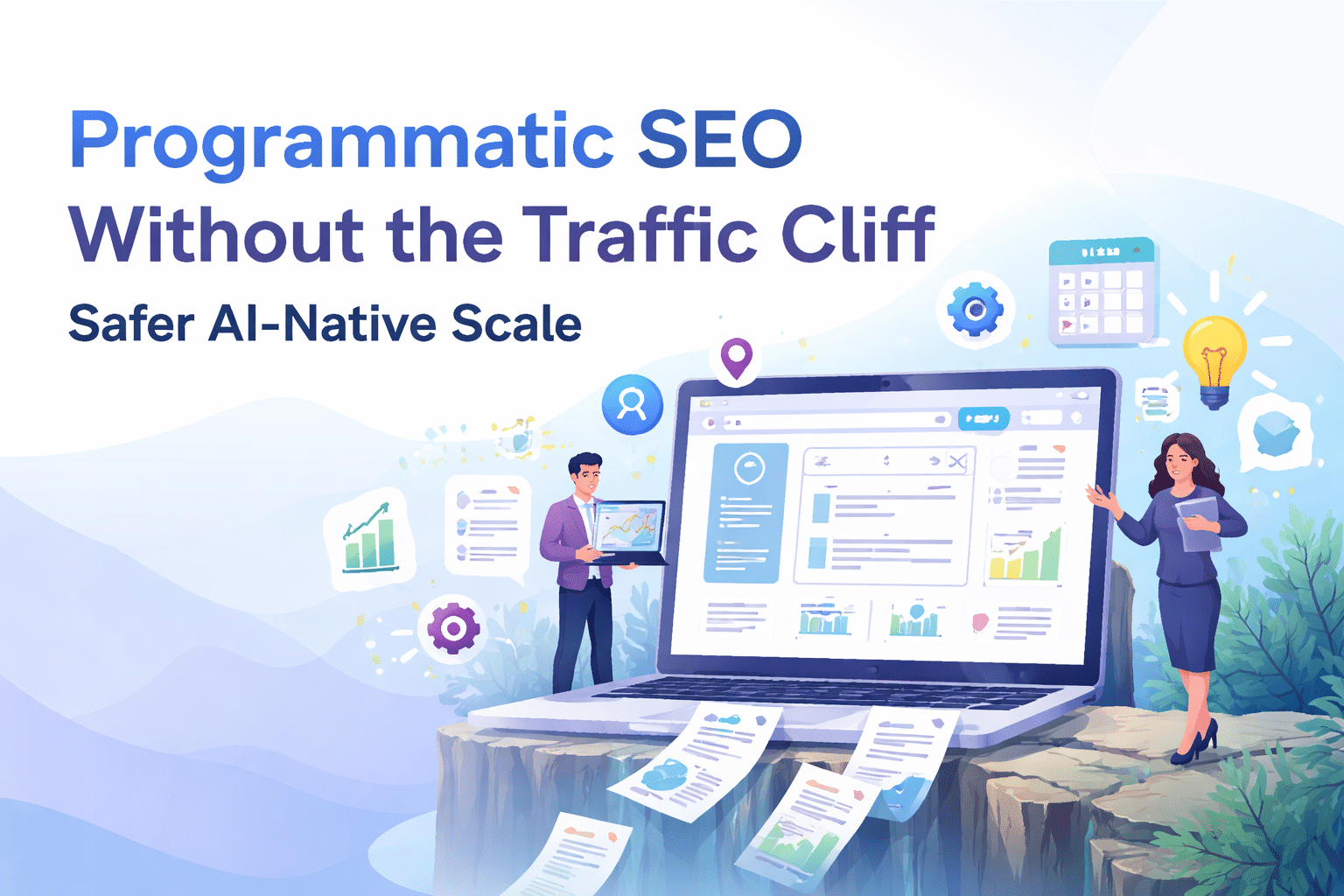
Programmatic SEO is a powerful way to grow organic traffic quickly, but it must be used carefully. Many teams like the idea of creating hundreds or even thousands of pages using templates and structured data. When done right, it can bring great results. But when done wrong, it can harm your website. It may create low-quality or duplicate pages, poor user experience, and weak engagement signals. This can lead to a sudden drop in rankings and traffic, often called a “traffic cliff.” This blog simplifies your original content and focuses only on the strategy, without mentioning any specific companies.
What programmatic SEO actually is
Programmatic SEO is a smart, system-based way to improve your search rankings. Instead of creating each page manually, you build a framework that uses structured data, templates, automation, and SEO rules to generate many pages at scale. These pages usually target common search patterns like locations, product comparisons, directories, calculators, service pages, or feature-based searches.
At its core, programmatic SEO is not just about creating a large number of pages. It is about using real data to build helpful pages that match user search intent. This is important. If you only replace keywords in a template, you are just creating more pages. But if you turn structured data into useful content, you create real value that can scale.
A strong programmatic SEO system has four key parts. First is the data layer, which provides the information that makes each page useful. Second is the template system, which defines how each page looks and is organized. Third is the generation engine, which creates and publishes pages efficiently. Fourth is the technical SEO setup, which helps search engines crawl, index, and understand your pages properly.
Why so many brands want it
The appeal is obvious. Traditional SEO is slow and expensive when every page requires manual research, writing, formatting, optimization, and publishing. Programmatic SEO changes the economics. Once the system is built, a site can produce pages far faster than a manual content team ever could. That makes it attractive for targeting long-tail search demand, where each individual keyword may have low search volume but the total opportunity across thousands of variations is large.
This is especially useful for queries that follow patterns. Think about searches like:
- service in a city
- product A vs product B
- best tool for a use case
- calculator for an industry
- directory pages by category or location
One keyword may bring only a few visits each month, but thousands of those pages together can create a substantial traffic channel. Programmatic SEO works because search demand is often fragmented. Instead of chasing only head terms, it allows a site to win across an entire query system.
Programmatic SEO vs normal SEO
Traditional SEO and programmatic SEO are not enemies. They solve different problems.
Traditional SEO is best when a page needs deep research, strong editorial voice, careful persuasion, original thought, or premium trust signals. It is ideal for cornerstone pages, thought leadership, complex topics, and highly competitive keywords. Programmatic SEO is best when the site has repeatable search patterns and enough unique data to produce useful pages at scale.
The biggest differences are scale, process, and risk. Traditional SEO grows steadily but more slowly. Programmatic SEO can grow very quickly, but the quality risk is much higher. Traditional SEO lets you perfect pages one by one. Programmatic SEO forces you to think in systems, thresholds, and monitoring. In short, manual SEO gives you precision; programmatic SEO gives you leverage.
The three practical models of SEO execution
In practice, most businesses fit into one of three models.
The first is manual SEO. This is fully human-led and usually produces the best editorial quality, but it is difficult to scale. It suits high-value pages and competitive topics where expertise matters more than page count.
The second is hybrid SEO. This combines automation or AI assistance with human review. It gives a better balance between speed and control and is often the safest choice for growing businesses.
The third is fully programmatic SEO. This is the most scalable and also the riskiest. It works best when the dataset is rich, the page patterns are consistent, and the technical and editorial controls are strong. Without those controls, it can create the exact signals that lead to loss of rankings.
When programmatic SEO works
Programmatic SEO works best when three conditions exist at the same time: unique data, clear search patterns, and real user value.
1. You have a real data advantage
The most successful programmatic SEO projects are built on datasets that are useful and difficult to copy. That could mean product specs, location intelligence, pricing data, comparison frameworks, user-generated reviews, availability details, technical metadata, or proprietary research. The data is what turns a template into a destination.
If your pages are based on data anyone can copy in an afternoon, your moat is weak. Search engines do not reward scale by itself. They reward usefulness. So the question is not “Can we generate 10,000 pages?” The real question is “Do we have 10,000 pages’ worth of distinct value?”
2. The keyword patterns are repeatable
Programmatic SEO thrives when search behavior follows structures. A query like “coffee shops in [neighborhood] with wifi open late” can be broken into reusable components. The same goes for filters, comparisons, directories, near-me intent, tools, pricing combinations, or industry-specific variations.
When the pattern is clear, you can design templates around what users consistently want. This is far more reliable than inventing pages first and hoping search demand will appear later.
3. Each page answers a specific intent
A programmatic page must still deserve to exist. It must solve a real user need better than a generic page would. That means the page should not just target a keyword pattern. It should satisfy the reason someone searched for that pattern. If the intent is comparison, the page needs comparison value. If the intent is local discovery, the page needs local usefulness. If the intent is calculation, the page must genuinely help someone calculate something.
The strongest programmatic pages do not feel auto-generated, even when they are system-generated. They feel focused, relevant, and complete.
Where programmatic SEO fails
Programmatic SEO usually fails for predictable reasons, not random bad luck. Most collapses happen because teams build for volume before they build for value. Your source material points to repeated failure patterns such as thin content, duplicate pages, intent mismatch, poor data quality, and over-optimization.
Thin content
Thin content is one of the clearest causes of failure. This happens when pages contain very little unique information, low depth, weak usefulness, or mostly template text. If every page says nearly the same thing and only swaps a city, feature, or product name, the page is unlikely to hold rankings over time.
Search engines may initially crawl and even rank such pages, especially if the site already has authority. But once user signals show the pages are not satisfying intent, those rankings can decline sharply.
Duplicate or near-duplicate pages
Programmatic SEO becomes dangerous when content differentiation is too low. If hundreds of pages are essentially copies with tiny keyword substitutions, they send the message that the site is manufacturing URLs rather than solving problems. Your source material highlights the importance of ensuring real differentiation across pages, not just structural variation.
Duplicate risk does not only mean identical text. It also includes pages that are technically different but functionally the same from a user’s perspective.
Search intent mismatch
This is one of the most overlooked problems. A page can match a keyword and still fail because it does not match the reason behind the search. For example, a user looking for local options expects real local information. A user comparing two products expects side-by-side insight. A user searching for pricing expects clarity, not a generic landing page.
When intent mismatch happens at scale, the damage compounds quickly. Bounce rates rise, dwell time falls, click satisfaction drops, and rankings can weaken across whole page groups.
Poor data quality
Automation does not fix bad data. It multiplies it. If the data layer is wrong, outdated, incomplete, or shallow, the page network will inherit those weaknesses. That can result in user distrust, indexing issues, or manual cleanup burdens that are much more expensive than doing the data work properly from the start.
Over-optimization
Programmatic systems often tempt teams to force keywords, overuse exact matches, repeat internal link patterns mechanically, or build unnatural page structures. At scale, small SEO mistakes become sitewide patterns. Search engines are good at spotting those patterns. A page framework should feel systematic but not robotic.
What a traffic cliff really is
A traffic cliff is not just “traffic went down.” It is a sharp, often sudden decline after a period of rapid scale. The pages may initially index and rank, and the project may look successful. Then performance drops hard, often because the site has accumulated too many low-value patterns. According to your source text, this decline often follows a recognizable path: early visibility, weakening user signals, ranking deterioration, and then a major fall.
This is what makes programmatic SEO so deceptive. It can look like a huge win before it becomes a serious problem. Early growth is not proof of sustainability.
How to avoid the traffic cliff
The safest way to do programmatic SEO is to treat it like product development, not bulk publishing. You do not launch everything at once. You validate, monitor, improve, and scale carefully.
Start with a pilot, not a flood
A small launch reveals what a massive launch hides. Start with a controlled batch of pages. Measure indexation, engagement, rankings, internal linking performance, crawl behavior, and conversions. Fix the weak spots before increasing the volume. Progressive rollout is one of the strongest protection methods because it catches system problems before they become sitewide liabilities.
Set minimum quality thresholds
Every page type should have clear standards. Those standards may include minimum unique word count, content completeness, data freshness, internal link presence, schema validity, page speed, and intent-specific usefulness. Your source material emphasizes using quality thresholds and stronger unique content requirements as a protective strategy.
The important idea is consistency. If you cannot define the minimum quality bar, you cannot safely automate publishing.
Monitor user signals weekly
Programmatic SEO is not “publish and forget.” It requires ongoing observation. Pages with weak engagement should be reviewed. Clusters with low indexation should be investigated. If certain patterns are failing, pause expansion until you know why. Your source material points to signals such as bounce rate, dwell time, indexation rate, and click-through trends as early warning signs.
Prune what does not deserve to stay
One of the hardest habits in programmatic SEO is deleting pages. But keeping weak pages just because they exist is often harmful. Monthly pruning helps remove low-performing, redundant, stale, or low-value URLs. A smaller, stronger site structure is often healthier than a bloated one.
Use internal linking intentionally
At scale, internal linking becomes both a discovery tool and a quality signal. Category hubs, related-page links, breadcrumbs, and contextual connections help search engines understand the site structure. They also help users move through the site in meaningful ways. Done well, this supports crawl efficiency and user engagement. Done badly, it becomes another mechanical footprint.
The safer AI-native approach
AI makes programmatic SEO more powerful, but it does not remove the need for editorial judgment. The safer model is not “AI writes everything.” The safer model is “AI helps scale workflows while humans control quality, intent, and strategic decisions.” Your source material supports a hybrid structure where automation handles the repeatable parts and humans oversee the critical ones.
AI can help with:
- structuring content variations
- generating metadata
- filling data-driven sections
- suggesting schema markup
- identifying content gaps
- scoring pages for quality checks
- improving internal link relevance
But AI should not be allowed to become an excuse for publishing shallow pages faster. Scale only helps when the underlying page experience is worth scaling.
A practical AI-native setup looks like this:
- programmatic page skeletons built from structured data
- AI-enhanced sections that add explanation or context
- human review of page samples and high-risk templates
- automated validation for duplication, metadata, schema, and link integrity
- performance dashboards that flag weak clusters early
That model is more sustainable because it accepts a simple truth: automation is excellent at repetition, but humans are still better at judgment.
How much human oversight is enough?
Not every page needs manual editing. But every system needs human ownership. A sensible review process can include template audits, sample-based page reviews, cluster-level performance checks, and expert review for sensitive topics. Your source material suggests using sampling and strict quality control rather than manually touching every URL.
This matters because the goal of oversight is not perfection on each page. The goal is confidence that the system produces acceptable outcomes consistently.
The best use cases for programmatic SEO
Programmatic SEO is especially strong when content comes from structured, repeated, user-relevant information. Good use cases include:
- location pages with meaningful local attributes
- comparison pages with true comparison value
- marketplaces and directories
- tools and calculators
- product catalogs with rich filters
- industry-specific resource pages built from real data
In all of these cases, the page count is justified because the demand pattern is real and the dataset provides differentiated value.
When not to use it
You should avoid programmatic SEO if your site does not have distinctive data, if the niche is too small, if trust requirements are extremely high, or if you do not have the capacity to maintain quality over time. Your source material also notes that some sectors require premium precision and should not rely heavily on scaled template content.
That is a crucial point. Programmatic SEO is not a shortcut for weak strategy. It works best when the business already has a reason to own a large set of pages.
A practical rollout plan
A safer launch can be thought of in three phases.
In the first phase, build the foundation. Audit the dataset, identify search patterns, design templates, define quality thresholds, and set up technical SEO properly. Then launch only a small batch.
In the second phase, validate. Study which pages index, which rank, which convert, and which disappoint users. Tighten the template and improve the weakest sections.
In the third phase, scale gradually. Expand only once the system has shown evidence of quality and performance. Continue monitoring, pruning, and refining rather than assuming scale alone will keep working.
Final verdict
Programmatic SEO still works, but not in the careless way many teams imagine. It works when a site has real data, clear search patterns, high-quality templates, solid technical SEO, and disciplined monitoring. It fails when businesses confuse page volume with page value. It becomes safer when AI is used as an assistant to a strong system rather than a replacement for strategy and editorial control.
The biggest lesson is simple: the goal is not to publish more pages. The goal is to create more useful pages without losing quality. If your system can do that, programmatic SEO can become one of the most powerful growth channels in organic search. If it cannot, the traffic cliff is not an accident. It is the natural outcome of scaling the wrong thing.