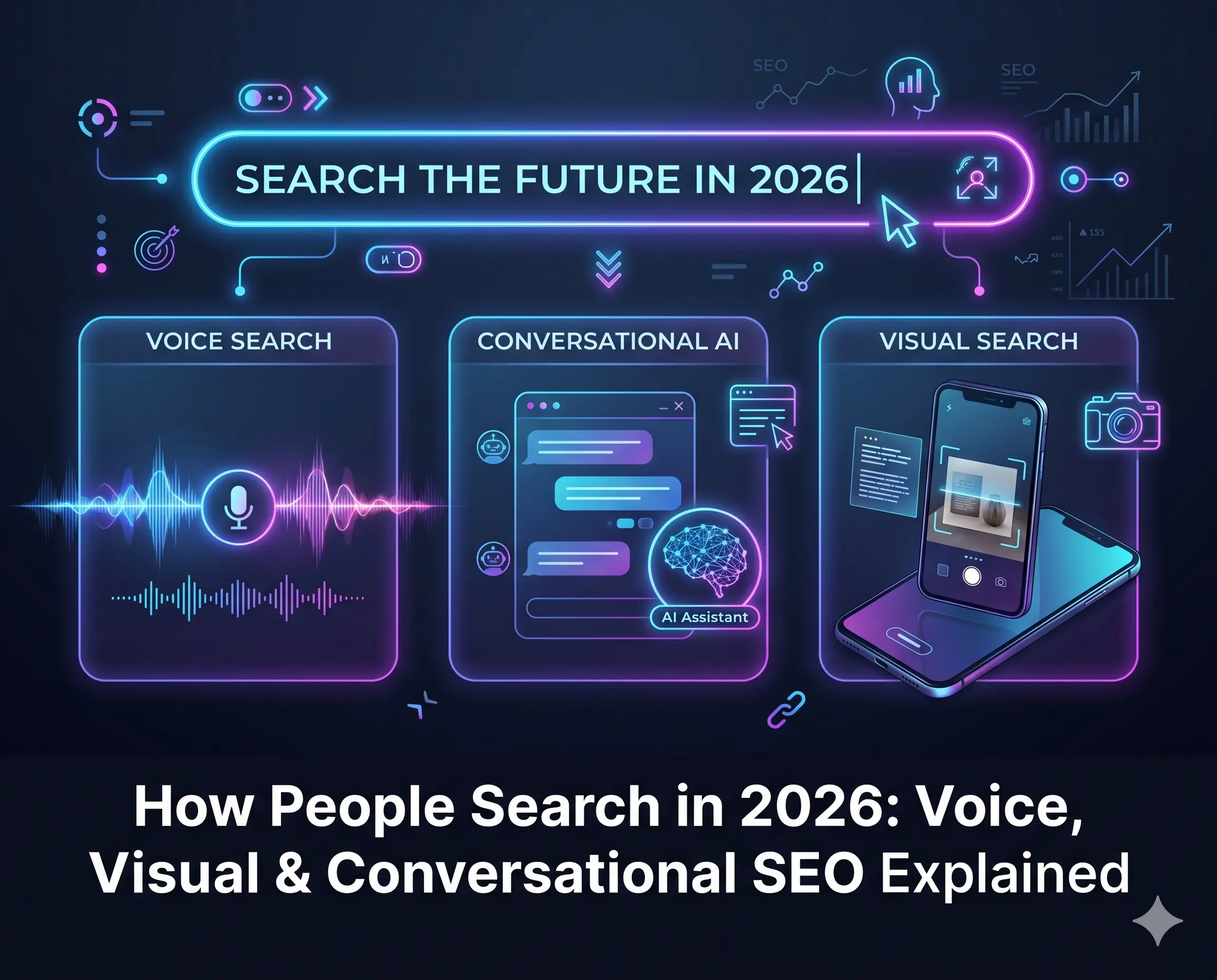
How People Search in 2026: Voice, Visual & Conversational SEO Explained
Think about the last five times you searched for something online. Did you type a two-word keyword into a search bar? Or did you ask a question — out loud to your phone, through a chat interface, or by snapping a photo of something you wanted to identify?
The way people search has changed more in the last three years than in the previous decade. The rigid, keyword-focused search behaviors that shaped SEO strategy for most of the internet era are being replaced by something far more natural, conversational, and multimodal. People are searching the way they talk, the way they think, and increasingly, the way they see.
For growth business owners, this shift is not a distant trend to prepare for eventually. It is happening right now, in the searches your potential customers are performing today. The businesses that understand how their audience actually searches in 2026 — and optimize accordingly — will capture visibility that their keyword-obsessed competitors are completely blind to.
This final guide in our Advanced SEO for 2026 series covers the three behavioral search channels reshaping organic visibility: voice, visual, and conversational search. You will understand exactly what each one is, how it works, and what you need to do to win in each channel.
What Is Behavioral SEO?
Behavioral SEO is the practice of optimizing your digital presence based on how people actually behave when they search — not how search tools were historically designed to be used.
Traditional SEO optimization was built around the assumption that users type short, precise keyword phrases into a text box. Two to four words. No punctuation. Stripped of context and natural language nuance. ‘best accounting software small business.’ ‘HR consultant Dubai.’ ’email marketing tips.’
That assumption no longer reflects reality for a growing share of searches. Modern search behavior is characterized by three major shifts:
- It is more verbal. Voice-activated searches through phones, smart speakers, and AI assistants are phrased as full, natural-language questions rather than keyword fragments.
- It is more visual. Users increasingly search by image — photographing a product, scanning a QR code, or using visual AI tools to identify and find items they see in the physical world.
- It is more conversational. AI chat interfaces like ChatGPT and Perplexity have normalized multi-turn, dialogue-style searches where users refine and follow up rather than running a series of independent queries.
Each of these behavioral shifts requires a distinct optimization approach. Together, they represent a complete rethinking of what it means to be discoverable in 2026.
🔍 Key Insight: Behavioral SEO doesn’t replace traditional keyword optimization — it extends it. Your existing SEO foundation (technical health, content quality, authority signals) is still essential. Behavioral SEO adds new optimization layers on top of that foundation to capture searches that keyword-only strategies miss entirely.
Voice Search: Optimizing for How People Actually Talk
Voice search has been ‘the next big thing’ for so long that many business owners have started dismissing it as overhyped. That’s a mistake. The reason voice search adoption took longer than predicted is that the technology wasn’t good enough to replace typing for most queries. In 2026, it is.
AI-powered voice assistants — embedded in phones, smart speakers, earbuds, car systems, and wearables — now understand natural speech with high accuracy across accents, dialects, and conversational phrasing. The friction that kept people typing is gone. And the behavioral shift is accelerating.
Voice search is particularly dominant in three contexts: hands-free situations (driving, cooking, exercising), quick factual lookups (weather, conversions, definitions), and local searches (‘find a coffee shop near me’). For growth businesses with local relevance or informational content, these contexts represent significant search volume.
How Voice Search Queries Differ from Typed Queries
The single most important thing to understand about voice search optimization is that voice queries are structurally different from typed queries. The same intent, expressed verbally, produces a dramatically longer, more natural-language query.
A typed query: ‘project management software remote teams’
The same query voiced: ‘What is the best project management software for a remote team of ten people?’
Notice the difference. The voice query includes question words, conversational context, a specific qualifier (‘ten people’), and full sentence structure. Optimizing for the typed version and the voiced version requires fundamentally different content approaches.
Voice Search Optimization Strategies
- Write content the way people speak. Read your content out loud. If it sounds unnatural, stiff, or like a keyword list — it won’t perform for voice search. Conversational writing with natural phrasing, contractions, and direct address (‘you’, ‘your’) is far more voice-search aligned than formal or jargon-heavy prose.
- Target question-based long-tail queries. Voice searches are overwhelmingly phrased as questions. Build content specifically around ‘who’, ‘what’, ‘where’, ‘when’, ‘why’, and ‘how’ questions in your niche. Use these questions as actual H2 and H3 subheadings — exactly as a user would phrase them verbally.
- Optimize for featured snippets and position zero. Voice assistants almost universally read out a single answer to voice queries — typically pulled from a featured snippet or top-ranked result. All the featured snippet optimization tactics covered in Blog #4 of this series apply directly here.
- Create a comprehensive FAQ strategy. FAQs are the single most voice-search-aligned content format because they mirror the question-and-answer structure of verbal search behavior. A robust FAQ page targeting the most common questions in your niche is both a voice search asset and a featured snippet opportunity.
- Prioritize local voice search signals. The most commercially valuable voice searches are local — ‘near me’ queries with immediate purchasing intent. Ensure your Google Business Profile is fully optimized, your NAP (name, address, phone) data is consistent across the web, and your local content uses natural geographic language.
💡 Pro Tip: Record five minutes of a real customer support call or sales conversation. Transcribe it. The questions your customers ask verbally are exactly the queries they use in voice search — and they are almost certainly different from the keywords you currently target. Use these transcripts as a voice search keyword research goldmine.
Visual Search: Optimizing for the Eyes
Visual search is the most rapidly growing and most underestimated search behavior shift in 2026. It is also the one most business owners have done essentially nothing to prepare for.
Visual search allows users to search using images rather than words. A user photographs a product they want to buy. They point their camera at a plant to identify its species. They screenshot an outfit from social media and search for where to buy it. They scan a piece of equipment to find its manual.
The tools enabling this behavior — Google Lens, Pinterest Lens, Bing Visual Search, and AI-powered image recognition built into mobile operating systems — have reached a level of accuracy and mainstream adoption that makes visual search a real, material channel for product-oriented and visually distinctive businesses.
Who Visual Search Matters Most For
Visual search is not equally relevant across all business types. It is most commercially significant for:
- E-commerce and retail businesses: Product discovery through visual search is accelerating. Users who find a product they like in the physical world or on social media increasingly search visually to find where to purchase it.
- Interior design, architecture, and home goods: Inspiration-to-purchase journeys in these categories are heavily image-driven. Visual search bridges the gap between ‘I saw this somewhere’ and ‘I want to buy this.’
- Fashion and apparel: Visual search is a primary discovery channel in fashion. Outfit screenshots and in-store photo searches drive significant product discovery traffic for brands optimized to capture it.
- Food and hospitality: Restaurant menu items, dishes seen on social media, and food product packaging are all subjects of frequent visual searches.
- Professional services with strong visual identity: Even service businesses benefit from visual search when their branding, team photos, or visual content ranks well in image results and feeds into Google Lens results.
Visual Search Optimization Strategies
- Make image SEO a first-class priority. Every image on your website should have a descriptive, keyword-relevant file name (not ‘IMG_4521.jpg’ but ‘ergonomic-office-chair-lumbar-support.jpg’), a fully completed alt text attribute, and a surrounding page context that reinforces the image’s subject matter.
- Use high-quality, original photography. Stock photos are essentially invisible in visual search because they appear on hundreds or thousands of other websites. Original photography of your products, team, and premises — taken at multiple angles with clear, uncluttered backgrounds — gives visual search algorithms distinct, attributable images to index.
- Implement product schema for e-commerce. Product schema markup tells Google exactly what is in your image — product name, price, availability, brand — making it far more likely to surface in visual search results with rich product data attached.
- Create and submit image sitemaps. An image sitemap tells Google’s crawlers about every image on your site and ensures they are all indexed. Many images on dynamically rendered websites are never indexed without an explicit sitemap submission.
- Build a Pinterest and visual platform presence. Pinterest is both a social platform and a visual search engine with hundreds of millions of active users. Businesses that consistently publish high-quality, well-described visual content on Pinterest create a second visual search discovery channel completely independent of Google.
- Optimize for Google Lens specifically. Google Lens triggers on images that appear in Google Image Search results. The best way to appear in Lens results is to rank in Google Images — which means investing in the image SEO fundamentals above and ensuring your pages with images are strongly optimized for their target topics.
⚠️ Watch Out: Do not compress images so aggressively that detail is lost. Visual search algorithms analyze image content — blurry, heavily compressed, or low-resolution images are harder for AI to interpret and rank. Find the balance between fast load times and sufficient image quality for clear visual recognition.
Conversational Search: Optimizing for Dialogue
Conversational search is the behavioral shift with the most profound long-term implications for SEO strategy — and the one that is most directly reshaping how growth businesses need to think about content.
When someone uses ChatGPT, Perplexity, Claude, or Google’s AI chat interface to research a topic, they don’t search once. They have a conversation. They ask a broad opening question, receive a synthesized answer, follow up with refinements, dig into specific aspects, compare options, and eventually arrive at a well-informed position — all within a single dialogue thread.
This is fundamentally different from the traditional search session, where each query was independent and each click started a new context. Conversational search is cumulative, contextual, and self-refining.
What Conversational Search Means for Content Strategy
The shift to conversational search has two major implications for how growth businesses should structure their content.
First, the full-funnel content gap matters more than ever. In a conversational search session, a user might move from awareness-level questions (‘what is performance management?’) to consideration-level questions (‘what are the best performance management platforms for small teams?’) to decision-level questions (‘how does Platform A compare to Platform B on pricing and integrations?’) — all within the same conversation thread. If your content only addresses one stage of this journey, you are invisible for the rest.
Second, answer completeness beats keyword density. AI chat systems don’t rank pages by keyword match — they select sources that provide the most complete, accurate, and contextually useful answer to the question being asked. A comprehensive piece that genuinely covers a topic from multiple angles will be cited far more frequently than a shallow piece that mentions the right keywords.
Conversational Search Optimization Strategies
- Map your content to the full conversational journey. For each core topic your business covers, map out the sequence of questions a prospect would ask in a natural research conversation — from initial curiosity through deep comparison to purchase decision. Ensure you have strong content addressing every stage. Gaps in this sequence are visibility gaps.
- Write in natural, dialogue-aware language. Conversational AI systems are trained on human dialogue. Content that reads naturally, uses plain language, and is structured around questions and answers integrates more smoothly into AI-generated conversational responses than academic or keyword-heavy writing.
- Build explicit topic bridges between content pieces. Within your pillar and cluster architecture, create content that explicitly connects related topics — ‘Now that you understand X, the next question is usually Y’ — mirroring the natural progression of a research conversation. These bridges help AI systems understand your content as a connected knowledge base, not an isolated collection of articles.
- Create comparison and versus content. Conversational search sessions frequently include comparison queries — users weighing their options before a decision. Dedicated comparison content (‘X vs Y: which is right for your business?’) directly addresses this conversational search behavior and tends to rank well in AI-generated responses for decision-stage queries.
- Optimize for follow-up questions, not just primary queries. Think about what questions naturally follow from your primary content. If someone reads your guide to setting up a remote team, their next question might be about remote team management tools, communication best practices, or time zone challenges. Create cluster content that answers these follow-up questions and links between them naturally.
💡 Pro Tip: Use AI assistants as a research tool for your own content strategy. Have a genuine conversation with ChatGPT or Perplexity about your core topics, exactly as a customer would. Pay attention to the follow-up questions the AI suggests and the gaps it identifies in each response. These are the conversational search opportunities your content library is currently missing.
The Intersection: Where Voice, Visual, and Conversational Search Converge
The most important development in behavioral search in 2026 is not any single channel in isolation — it is the convergence of all three into unified, multimodal search experiences.
Consider a scenario unfolding millions of times daily. A user is in a store and photographs a product with their phone. Google Lens identifies the item and surfaces visual search results. They then ask their voice assistant a follow-up question about the product’s reviews. The assistant pulls from conversational AI to synthesize a response. The user then asks a comparison question via text in a chat interface.
This is one search session spanning all three behavioral channels — visual, voice, and conversational. The business that appears at each touchpoint wins the attention and, ultimately, the purchase.
For growth businesses, this convergence has a clear strategic implication: the businesses that win behavioral search are not those that optimize for one channel but those that build a presence comprehensive enough to appear wherever the search journey takes the user.
Behavioral SEO and Page Experience: The Technical Foundation
No behavioral SEO strategy works if the underlying page experience is poor. Voice search results deliver users to fast, mobile-optimized pages — or not at all. Visual search leads to image-rich, well-structured product pages — or dead ends. Conversational search citations drive traffic to pages that load instantly and answer questions immediately — or bounce immediately.
The technical page experience factors that underpin behavioral SEO performance are:
- Mobile-first performance: The overwhelming majority of voice and visual searches happen on mobile devices. Pages that load slowly, render poorly on small screens, or require pinching and zooming fail behavioral search users at the first click.
- Core Web Vitals: Google’s Core Web Vitals — Largest Contentful Paint, Interaction to Next Paint, and Cumulative Layout Shift — are direct signals of page experience quality and influence ranking eligibility for rich results and featured positions.
- Structured data completeness: Schema markup is the technical language that makes your content interpretable by voice assistants, visual search algorithms, and AI chat systems. Every page targeting behavioral search traffic should have appropriate schema implemented.
- Page speed on mobile networks: Voice and visual searches frequently occur on cellular connections, not Wi-Fi. Test your page performance on 4G and 5G connections, not just broadband. A page that loads in 1.5 seconds on Wi-Fi may take 4+ seconds on a mobile network.
⚠️ Watch Out: Run a Google PageSpeed Insights test on your five most important pages right now. If any of them score below 70 on mobile, behavioral search optimization efforts built on top of them will be significantly undermined. Technical performance is the non-negotiable foundation.
Building a Behavioral SEO Measurement Framework
Measuring behavioral SEO performance requires tracking signals across multiple channels that traditional analytics dashboards were not built to capture. Here is a practical measurement framework for growth businesses:
Voice Search Metrics
- Featured snippet count and query coverage: Track how many of your pages hold featured snippet positions for question-based queries using Google Search Console and third-party tools.
- Question-format query impressions: Filter your Search Console data to show only queries phrased as questions (starting with who, what, where, when, why, how). Track impressions and click-through rates for these separately from standard keyword queries.
- Local search impressions and actions: Google Business Profile insights show how many users found you via voice-style ‘near me’ searches, and what actions they took (calls, direction requests, website visits).
Visual Search Metrics
- Google Images impressions and clicks: Search Console’s Search Type filter allows you to view performance data specifically from Google Images — the primary source of Google Lens results.
- Pinterest referral traffic: Track referral traffic from Pinterest in your analytics platform. Growth in Pinterest referrals indicates improving visual search discovery.
- Image indexation rate: Use Google Search Console’s URL Inspection tool to verify that your most important product and content images are indexed and appearing in image search results.
Conversational Search Metrics
- AI referral traffic: Monitor your analytics for referral traffic from AI platforms — Perplexity, ChatGPT’s browsing mode, and others increasingly pass referral data.
- Long-tail query growth: Conversational search drives longer, more specific queries. Track the growth of queries with five or more words in your Search Console data as a proxy for conversational search visibility.
- Content depth engagement: Users arriving from conversational AI citations tend to read more deeply. Track scroll depth and time on page for content pieces optimized for conversational search to measure quality of this traffic.
Putting It All Together: Your Behavioral SEO Action Plan
Behavioral SEO can feel overwhelming when you consider voice, visual, and conversational search simultaneously. The key is sequencing your investment based on where your audience is most active and where the effort-to-impact ratio is highest for your specific business.
Month 1–2: Foundation
- Audit your top 20 pages for mobile performance and Core Web Vitals. Fix any pages scoring below 70 on mobile PageSpeed.
- Add FAQ schema to your five most important content pages and your homepage.
- Complete a full Google Business Profile optimization — every field, fresh photos, FAQ entries, and a review collection process.
- Conduct a voice search keyword audit using customer support transcripts and PAA box research. Identify 10–15 question-format queries to target.
Month 3–4: Content Expansion
- Create or reformat three to five pieces of content specifically targeting the voice search questions identified in Month 1.
- Conduct an image SEO audit — rename image files, complete alt text, and submit an image sitemap if not already in place.
- Map your content library against the full conversational journey for your top two revenue-driving topics. Identify and plan content for the gaps.
Month 5–6: Channel Expansion
- Launch or optimize a Pinterest business profile if visual search is relevant to your category. Publish original visual content consistently.
- Build out comparison and versus content for your top competitive queries — these are high-value conversational search targets.
- Implement product schema on all e-commerce or service pages if not already complete.
💡 Pro Tip: Behavioral SEO compounds faster than traditional SEO because you are capturing demand that your competitors are not yet competing for. The question-format queries, visual search opportunities, and conversational search gaps in most industries are relatively uncrowded in 2026. Move quickly and the first-mover advantage is significant.
The Bigger Picture: Behavioral SEO as Business Strategy
Every guide in this Advanced SEO for 2026 series has pointed toward the same underlying truth: the businesses winning in search are not the ones trying to game an algorithm. They are the ones that genuinely understand their customers — how they think, what they need, and how they search — and build their content and digital presence around that understanding.
Behavioral SEO is the purest expression of this principle. It starts not with keyword tools or technical audits, but with a human question: how does my customer actually behave when they are looking for what I offer?
When your customer is driving and asks their phone a question, are you the answer they hear? When they photograph a product on a shelf and wonder where to find it online, does your brand surface? When they open an AI chat interface at midnight to research a problem your business solves, does your content appear in the conversation?
These are the moments of discovery that drive growth in 2026. They happen in voice, in images, and in conversations — not just in typed keyword searches. The businesses that show up consistently across all of these behavioral channels build something more valuable than search rankings: they build genuine, sustained presence in the lives of their potential customers.
That is what advanced SEO looks like in 2026. Not a collection of technical tricks. A systematic commitment to being genuinely discoverable — wherever, however, and whenever your customers search.
Series Complete: Advanced SEO for 2026
This is the fifth and final article in the Advanced SEO for 2026 series for growth business owners. The complete series covers:
- Beyond Google: How to Get Your Brand Cited by AI Search Engines in 2026
- The Pillar & Cluster Blueprint That Keeps You Ranking When AI Rewrites the Rules
- How to Build Unshakeable Trust Signals Google Can’t Ignore in 2026
- No Click, No Problem: How to Win SEO Visibility Without a Single Website Visit
- How People Search in 2026: Voice, Visual & Conversational SEO Explained