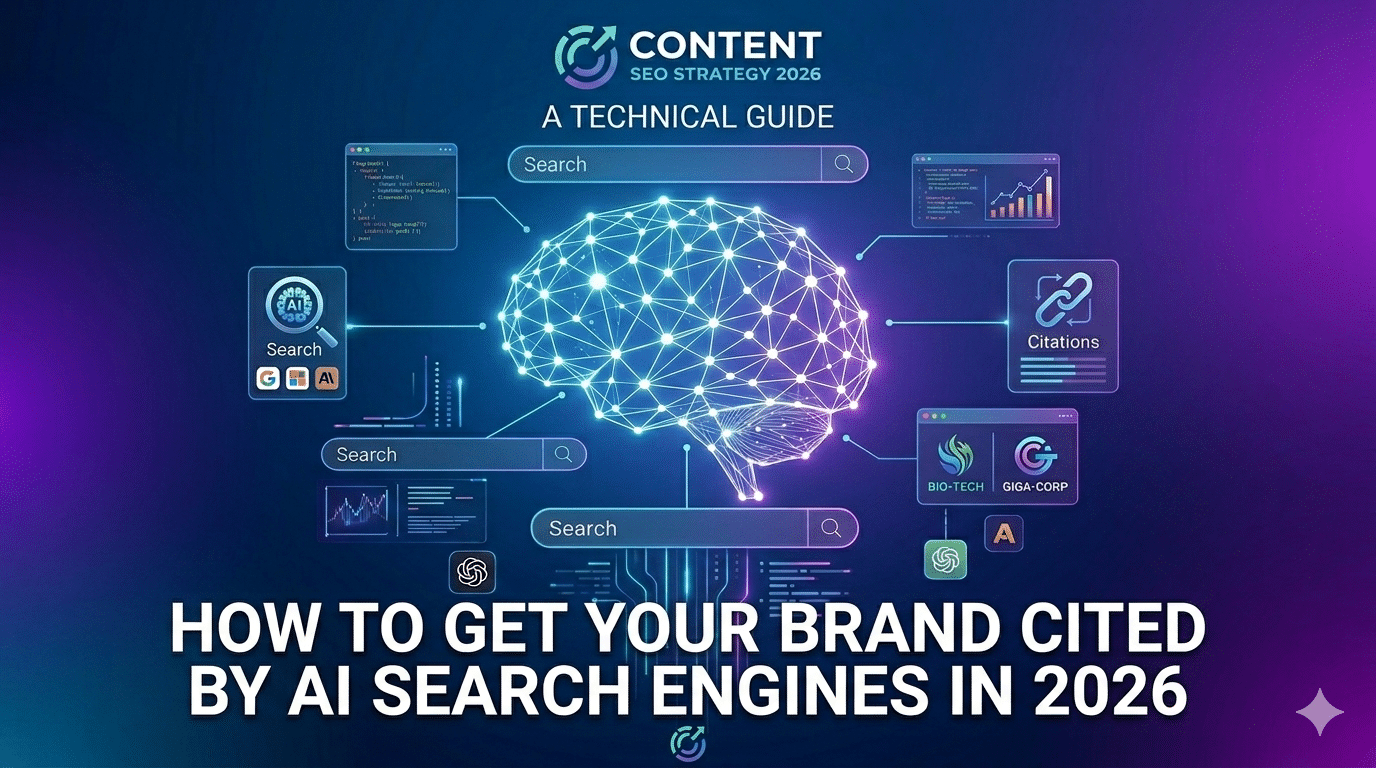
How to Get Your Brand Cited by AI Search Engines in 2026
Let’s be honest — if you’re a growth-focused business owner, you’ve probably noticed something strange happening with your website traffic. You’re still ranking on Google, but fewer people are clicking through. Customers are getting their answers directly from ChatGPT, Perplexity, or Google’s AI Overviews — without ever visiting your site.
This isn’t a glitch. It’s the new reality of search in 2026. And the businesses that are winning aren’t just optimizing for Google rankings anymore — they’re optimizing to be cited by AI.
Welcome to the world of Generative Engine Optimization, or GEO. In this guide, you’ll learn exactly what it is, why it matters for your business, and the practical steps you can take today to get your brand mentioned inside AI-generated answers.
What Is Generative Engine Optimization (GEO)?
Generative Engine Optimization (GEO) is the practice of structuring your content strategy and brand presence so that AI-powered search engines — like ChatGPT, Perplexity, Google AI Overviews, and Gemini — reference your business when answering user queries.
Traditional SEO focuses on ranking your website on a search results page. GEO focuses on something more powerful: becoming the trusted source that AI systems pull from when they generate answers.
Think of it this way. When someone asks ChatGPT ‘What’s the best project management software for small teams?’ — the AI doesn’t show a list of blue links. It gives a synthesized answer, citing specific brands and sources. GEO is the discipline of making sure your brand is one of those citations.
💡 Pro Tip: GEO doesn’t replace traditional SEO — it builds on top of it. The foundations of good SEO (quality content, strong backlinks, technical health) still matter. GEO adds a new layer on top.
Why Growth Business Owners Can’t Ignore This
If you’re scaling a business, visibility is everything. Here’s why GEO should be at the top of your marketing agenda in 2026:
1. AI Search Is Where Your Customers Are Going
Millions of business decision-makers now start their research by asking an AI assistant rather than typing into Google. If your brand doesn’t show up in those AI-generated responses, you’re invisible to an entire segment of high-intent buyers.
2. Early Movers Have a Massive Advantage
GEO is still an emerging field. Most of your competitors haven’t started thinking about it yet. Businesses that build GEO authority now will be extremely difficult to displace in AI results — just like the brands that dominated Google’s first page in 2005 still tend to rank well today.
3. AI Citations Drive High-Quality Traffic
When an AI recommends your brand by name, the people who then seek you out are already primed to trust you. This is warmer traffic than a cold organic click — and it converts at a higher rate.
How AI Search Engines Actually Work
To optimize for AI, you need to understand how these systems select the information they use. There are two main types of AI search behavior:
- RAG systems like Perplexity actively search the web in real time, retrieve relevant content, and synthesize an answer. Your content needs to be findable, crawlable, and authoritative. Retrieval-Augmented Generation (RAG):
- Models like ChatGPT are influenced by their training data — the vast body of content they were trained on. Brands that are consistently mentioned across the web in reputable contexts tend to appear more often in responses. Training Data Influence:
The practical implication: you need to be both highly visible online AND consistently associated with specific topics and expertise areas.
5 GEO Strategies Growth Business Owners Can Implement Now
Strategy 1: Own a Specific Topic Niche
AI systems favor sources that are recognized authorities on a specific topic. Broad, generic content doesn’t perform well in GEO — deep, specific expertise does.
Action step: Identify the 3–5 core topics that your business owns. Build a comprehensive content hub around each one — detailed guides, FAQs, case studies, and data. The goal is to become the definitive resource that AI systems associate with that topic.
💡 Pro Tip: Instead of writing about ‘marketing tips,’ write about ‘retention marketing for SaaS businesses with under 50 employees.’ The more specific your niche, the more likely AI is to cite you.
Strategy 2: Use Structured Data and Schema Markup
AI systems, especially those that crawl the web in real time, use structured data to understand what your content is about. Schema markup is essentially a language you use to tell AI and search engines exactly what your page contains.
For growth businesses, the most important schema types to implement are:
- Organization schema — tells AI who you are, what you do, and where you operate
- Article and BlogPosting schema — signals that your content is authoritative and dated
- FAQ schema — formats common questions and answers in a way AI systems love to pull from
- Product and Service schema — gives AI precise, structured information about your offerings
If you’re on WordPress, plugins like RankMath or Yoast make this straightforward. On custom platforms, work with your developer to implement JSON-LD schema.
Strategy 3: Build Your Brand’s Entity Presence
In the world of AI search, an ‘entity’ is a clearly defined person, place, organization, or concept that can be uniquely identified. Brands that have strong entity presence — meaning they are consistently referenced, described, and linked to across the web — are far more likely to be cited by AI.
How to build entity presence as a growth business:
- Claim and fully complete your Google Business Profile
- Ensure your business is listed consistently across major directories: Yelp, LinkedIn, Crunchbase, industry directories
- Get featured in industry publications, podcasts, and round-up articles
- Build a Wikipedia page if your business meets the notability threshold
- Encourage customers to leave reviews that mention your product category and key benefits
Strategy 4: Create Direct-Answer Content
AI systems are designed to answer questions. They naturally gravitate toward content that is formatted to answer specific questions directly and clearly.
This means shifting some of your content strategy toward what SEOs call ‘position zero’ style content — clear, concise, authoritative answers that don’t require the reader to dig through paragraphs to find the response they need.
Practical formats that work well for GEO:
- FAQ pages that address the exact questions your customers ask AI assistants
- ‘What is X’ and ‘How to Y’ guides with crisp, factual answers in the first paragraph
- Comparison pages that objectively assess your category (not just promotional content)
- Data-backed statistics and original research — AI systems love citing original data
💡 Pro Tip: Audit your current content by asking: ‘If I pasted this into ChatGPT, would it pull a clean answer from it?’ If not, restructure the opening to lead with the answer.
Strategy 5: Cultivate Third-Party Mentions and Backlinks
AI systems are heavily influenced by what other reputable sources say about you. A brand that is consistently mentioned, recommended, and cited by others carries far more weight than one that only publishes about itself.
For growth businesses, this means investing in:
- PR and media outreach — even one placement in a well-known industry publication can significantly boost your entity authority
- Podcast appearances where hosts mention your brand name, website, and expertise area
- Guest articles on reputable platforms in your niche
- Case studies and testimonials from credible customers that can be published externally
- Strategic partnerships with complementary brands that cross-reference each other
Measuring GEO Performance
Unlike traditional SEO where you track rankings and clicks, GEO requires a different measurement framework. Here’s what to monitor:
- Regularly query AI tools (ChatGPT, Perplexity, Gemini) with your target keywords and track how often your brand appears in the responses. AI citation frequency:
- An increase in branded searches on Google often indicates that AI mentions are driving awareness. Track your brand name in Google Search Console. Brand search volume:
- Tools like Perplexity and some AI browsers now pass referral data. Monitor your analytics for AI-sourced traffic. Referral traffic from AI:
- Survey your market or use social listening tools to assess how often your brand is mentioned relative to competitors. Share of voice in your category:
There’s no perfect GEO analytics dashboard yet — the space is still maturing. But consistent manual auditing combined with brand search monitoring gives you a reliable signal.
Common Mistakes to Avoid
As you build your GEO strategy, watch out for these pitfalls that slow down growth business owners:
- AI systems are increasingly good at identifying low-quality, formulaic content. Thin content created purely for volume will not earn citations. Publishing generic AI-generated content at scale:
- Many businesses sit on years of valuable content that simply isn’t structured for AI retrieval. An audit and refresh of existing assets is often the fastest GEO win. Ignoring your existing content library:
- ChatGPT, Perplexity, and Gemini are all distinct ecosystems with different ranking factors. Build presence across all of them. Focusing only on Google:
- AI systems update constantly. GEO is an ongoing practice, not a one-off optimization. Treating GEO as a one-time project:
The Bottom Line for Growth Business Owners
The search landscape in 2026 has fundamentally changed. Ranking on page one of Google is no longer enough — your brand needs to be present in the conversations happening inside AI systems, where an increasing share of your customers are making purchasing decisions.
Generative Engine Optimization is not a replacement for traditional SEO. It’s the next evolution of it. And the businesses that invest in GEO now — building deep topical authority, structured data, entity presence, and a strong web of third-party mentions — will have a significant and durable competitive advantage.
Start with one strategy from this guide this week. Audit your top five content pieces for direct-answer formatting. Set up schema markup on your homepage. Reach out to one industry publication for a guest feature opportunity. Small, consistent actions compound quickly in GEO.
The businesses getting cited by AI in 2026 aren’t the biggest — they’re the ones who understood this shift earliest and acted on it. using this Your Brand get Cited by AI Search Engines in 2026.