On-Page vs Off-Page SEO: Complete Guide to Ranking Higher on Google (2026 Edition)
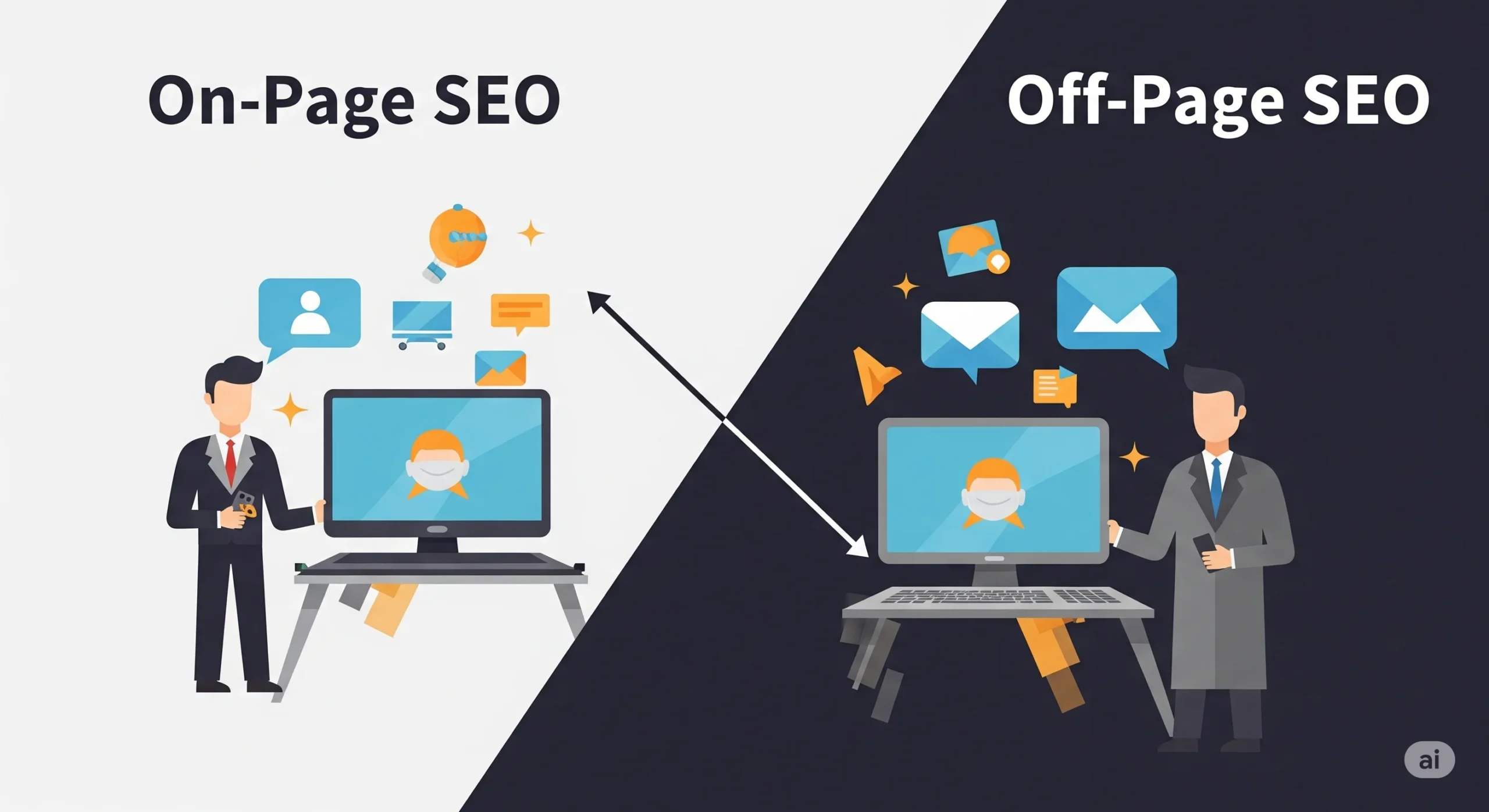
Search Engine Optimization (SEO) is no longer just about adding keywords to your content. In 2026, ranking on Google requires a holistic strategy that combines on-page SEO (what you control) and off-page SEO (how the internet perceives your site).
Many websites fail because they focus on only one side. The truth is:
👉 On-page SEO builds relevance. Off-page SEO builds authority. You need both to win.
This in-depth guide will walk you through everything you need to know—from fundamentals to advanced strategies.
What Is On-Page SEO?
On-page SEO refers to optimizing all elements within your website to help search engines understand your content and rank it appropriately.
It includes:
- Content quality
- HTML structure
- User experience
- Technical performance
The Goal of On-Page SEO
- Match search intent
- Improve crawlability & indexing
- Deliver excellent user experience
Advanced On-Page SEO Factors (2026)
1. Search Intent Optimization (MOST IMPORTANT)
Google prioritizes intent over keywords.
There are 4 types of intent:
- Informational (learn something)
- Navigational (find a website)
- Transactional (buy something)
- Commercial (compare options)
👉 If your content doesn’t match intent, it won’t rank—no matter how optimized it is.
2. Content Depth & Topical Authority
Thin content no longer works.
To rank:
- Cover topics comprehensively
- Answer related questions (People Also Ask)
- Use semantic keywords and entities
👉 Build topic clusters, not just single posts.
3. E-E-A-T (Experience, Expertise, Authority, Trust)
Google evaluates:
- Author credibility
- Content accuracy
- Website reputation
How to improve E-E-A-T:
- Add author bios
- Cite credible sources
- Include real-world experience
4. Content Structure & Readability
Well-structured content improves:
- User engagement
- Time on page
- SEO rankings
Best practices:
- Short paragraphs (2–3 lines)
- Use bullet points
- Add clear headings
- Avoid jargon
5. Keyword Strategy (Modern SEO)
Forget keyword stuffing.
Instead:
- Use primary keyword (main topic)
- Add secondary keywords
- Include LSI/semantic keywords
👉 Google understands context, not just exact matches.
6. Internal Linking Strategy
Internal links help:
- Spread authority (link equity)
- Guide users
- Improve indexing
Advanced tip:
- Use hub-and-spoke model
- Pillar page → multiple related articles
7. Core Web Vitals & Page Experience
Google ranks sites based on user experience signals:
- Largest Contentful Paint (LCP) – loading speed
- First Input Delay (FID) – interactivity
- Cumulative Layout Shift (CLS) – visual stability
👉 A slow or unstable site = lower rankings.
8. Mobile-First Optimization
Google indexes mobile versions first.
Your site must:
- Be responsive
- Load quickly on mobile
- Have easy navigation
9. Schema Markup & Rich Results
Structured data helps you win:
- Featured snippets
- FAQ results
- Review stars
👉 This increases click-through rate dramatically.
10. Technical SEO (Critical Layer)
Includes:
- XML sitemaps
- Robots.txt
- Canonical tags
- Fixing crawl errors
Without technical SEO, your content may never rank.
What Is Off-Page SEO?
Off-page SEO refers to actions taken outside your website to improve its authority, trustworthiness, and popularity.
Google uses off-page signals to answer:
👉 “Can this site be trusted?”
Advanced Off-Page SEO Factors
1. Backlinks (Still #1 Ranking Factor)
Backlinks act as votes of confidence.
But not all links are equal.
High-quality backlinks:
- Come from authoritative sites
- Are relevant to your niche
- Are editorial (earned, not spammy)
Types of backlinks:
- Do-follow (pass SEO value)
- No-follow (indirect value)
- Sponsored / UGC
2. Link Building Strategies (2026)
Effective methods include:
✔️ Guest posting
✔️ Digital PR campaigns
✔️ Skyscraper technique
✔️ Broken link building
✔️ Resource link building
👉 Focus on earning links, not building spammy ones.
3. Brand Authority & Mentions
Google tracks:
- Brand searches
- Mentions (even without links)
👉 Strong brands rank faster and easier.
4. Social Media Amplification
While not a direct ranking factor, social media:
- Drives traffic
- Increases visibility
- Helps earn backlinks
5. Influencer & Creator Collaboration
Partnering with:
- Bloggers
- YouTubers
- Industry experts
Helps you:
- Gain exposure
- Build trust
- Earn natural links
6. Content Distribution Strategy
Publishing content isn’t enough.
You must distribute via:
- Email marketing
- Communities (Reddit, Quora)
- Social platforms
7. Local SEO & Citations
For local businesses:
- Google Business Profile optimization
- Directory listings
- NAP consistency
8. Online Reputation & Reviews
Reviews impact:
- Trust
- Conversions
- Local rankings
On-Page vs Off-Page SEO: Deep Comparison
| Aspect | On-Page SEO | Off-Page SEO |
|---|---|---|
| Purpose | Improve relevance | Build authority |
| Control | Full control | Limited control |
| Speed of results | Faster | Slower |
| Key driver | Content & UX | Backlinks & trust |
| Risk | Low | High (if spammy links) |
How Google Combines On-Page & Off-Page SEO
Google’s algorithm works like this:
- Crawl & index your content (on-page + technical SEO)
- Understand relevance (keywords, intent, structure)
- Evaluate authority (backlinks, mentions)
- Measure user experience (behavior signals)
👉 Only pages that perform well in all areas rank consistently.
Complete SEO Strategy (Step-by-Step)
Step 1: Build a Strong On-Page Foundation
- Perform technical audit
- Fix site speed
- Optimize all pages
Step 2: Create High-Value Content
Focus on:
- Long-form guides
- Problem-solving content
- Data-driven insights
Step 3: Build Topical Authority
- Publish clusters of related content
- Interlink them strategically
Step 4: Earn Backlinks
- Outreach campaigns
- Guest blogging
- PR strategies
Step 5: Promote Aggressively
- Social media
- Email list
- Communities
Step 6: Track & Optimize
Monitor:
- Rankings
- CTR
- Bounce rate
- Backlinks
Common SEO Mistakes to Avoid
❌ Keyword stuffing
❌ Buying low-quality backlinks
❌ Ignoring mobile optimization
❌ Thin or duplicate content
❌ Slow page speed
Future of SEO (2026 & Beyond)
SEO is evolving rapidly.
Key trends:
- AI-generated content (needs human editing)
- Voice search optimization
- Search intent dominance
- Zero-click searches
- Visual & video SEO
Final Thoughts
On-page and off-page SEO are not separate strategies—they are two sides of the same coin.
- On-page SEO ensures your site is optimized and relevant
- Off-page SEO ensures your site is trusted and authoritative
👉 If you want consistent rankings, traffic, and growth—you must invest in both.
FAQs
Which is more important: on-page or off-page SEO?
Both are equally important. On-page builds relevance; off-page builds authority.
How long does SEO take?
- On-page improvements: 2–4 weeks
- Off-page impact: 3–6 months
Can I do SEO without backlinks?
Only in low-competition niches. For competitive keywords, backlinks are essential.